Water-stressed nations and communities
Help regions facing severe scarcity or “water bankruptcy” investigate locally appropriate ways to recover more usable water from available sources.
Potential applicationVortex physics · Controlled vapor · Water recovery
Blue Vortex Technologies is exploring a new water-recovery platform for a future in which communities, river systems, and economies can no longer afford to lose usable water.
When demand outruns reliable supply, water becomes more than a resource. It becomes a limit on human possibility.
Blue Vortex Technologies is being developed as a potential new tool within the larger water-resilience solution: recovering usable water from difficult sources, supporting reuse, and helping communities reduce pressure on rivers, reservoirs, and freshwater supplies.
A platform with multiple paths
Blue Vortex Technologies would not replace sound conservation, established treatment, or responsible watershed management. Its potential is to add another recovery tool where conventional supplies and systems are under increasing strain.
Help regions facing severe scarcity or “water bankruptcy” investigate locally appropriate ways to recover more usable water from available sources.
Potential applicationSupport the West by helping cities and industries recover and reuse water that might otherwise require additional withdrawals from an already stressed river system.
Potential applicationFit within a broader treatment train to recover water for reuse, including data-center cooling-tower blowdown, reduce avoidable discharge, and help turn wastewater from a disposal problem into a dependable resource.
Potential applicationReduce demand on freshwater sources and potentially help communities protect rivers, groundwater, coastal waters, and ecosystems through greater reuse.
Potential applicationA foundation of invention
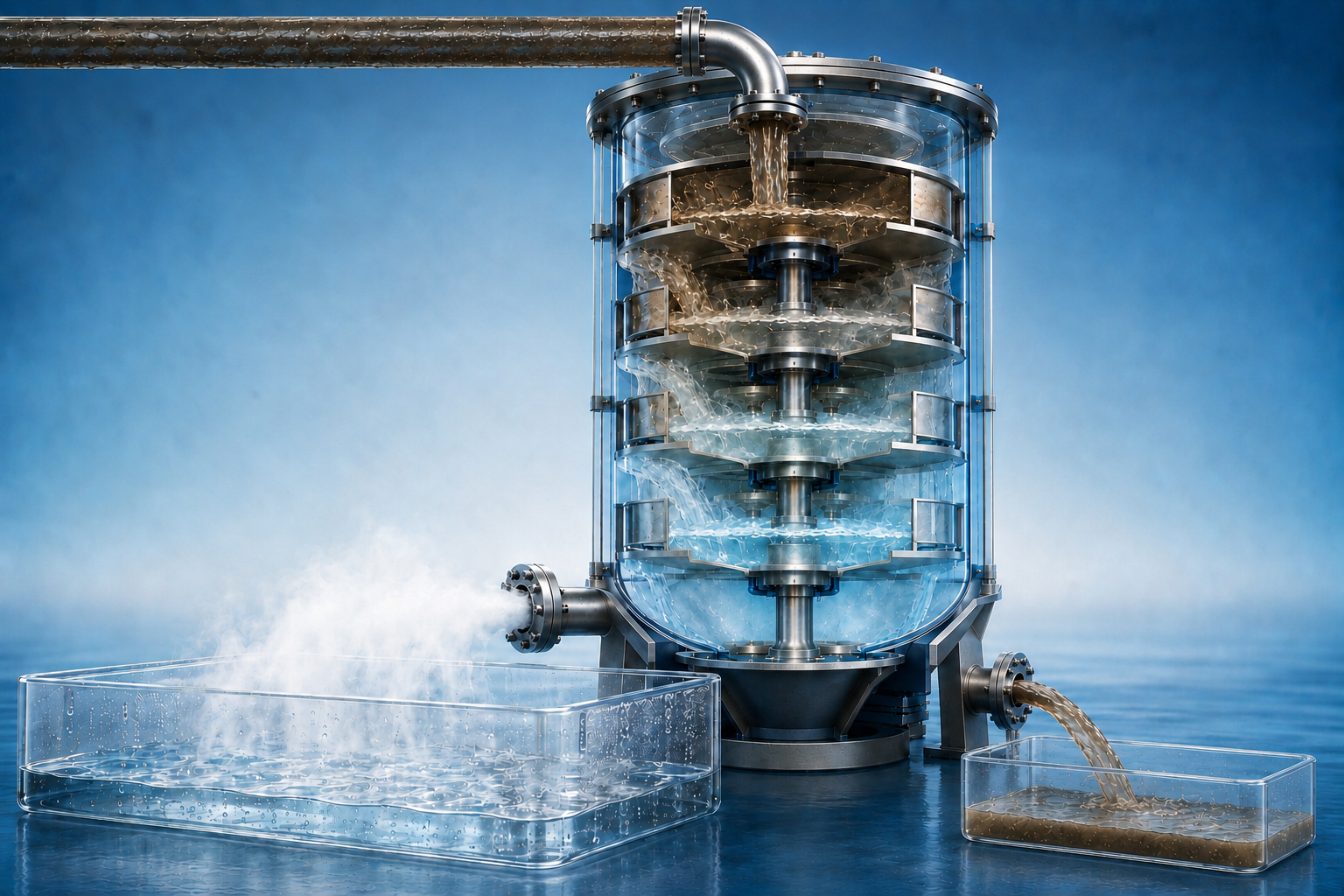
U.S. Patent 4,287,026, “Desalinization method,” applied multi-stage rotational principles to saltwater, separating salts and minerals from water vapor and directing the vapor toward condensation. It developed from Wallace’s earlier mechanical foundation, U.S. Patent 3,606,569, “Multi-stage compressor,” which established a rotating-disc architecture with staged horizontal discs, tubular scoops, fixed flow-straightening elements, and a central shaft. The later Verno water-vapor patents carried the development forward. Blue Vortex Technologies’ proposed MVP is a smaller, more observable, and more precisely engineered prototype designed around new geometry to optimize the technology’s core vapor engine.
The continuing development
Verno Holdings’ later patent connects a horizontal multi-disk processing vessel with feed handling, vapor recovery, brine reprocessing, trace-element recovery, and potable-water storage.
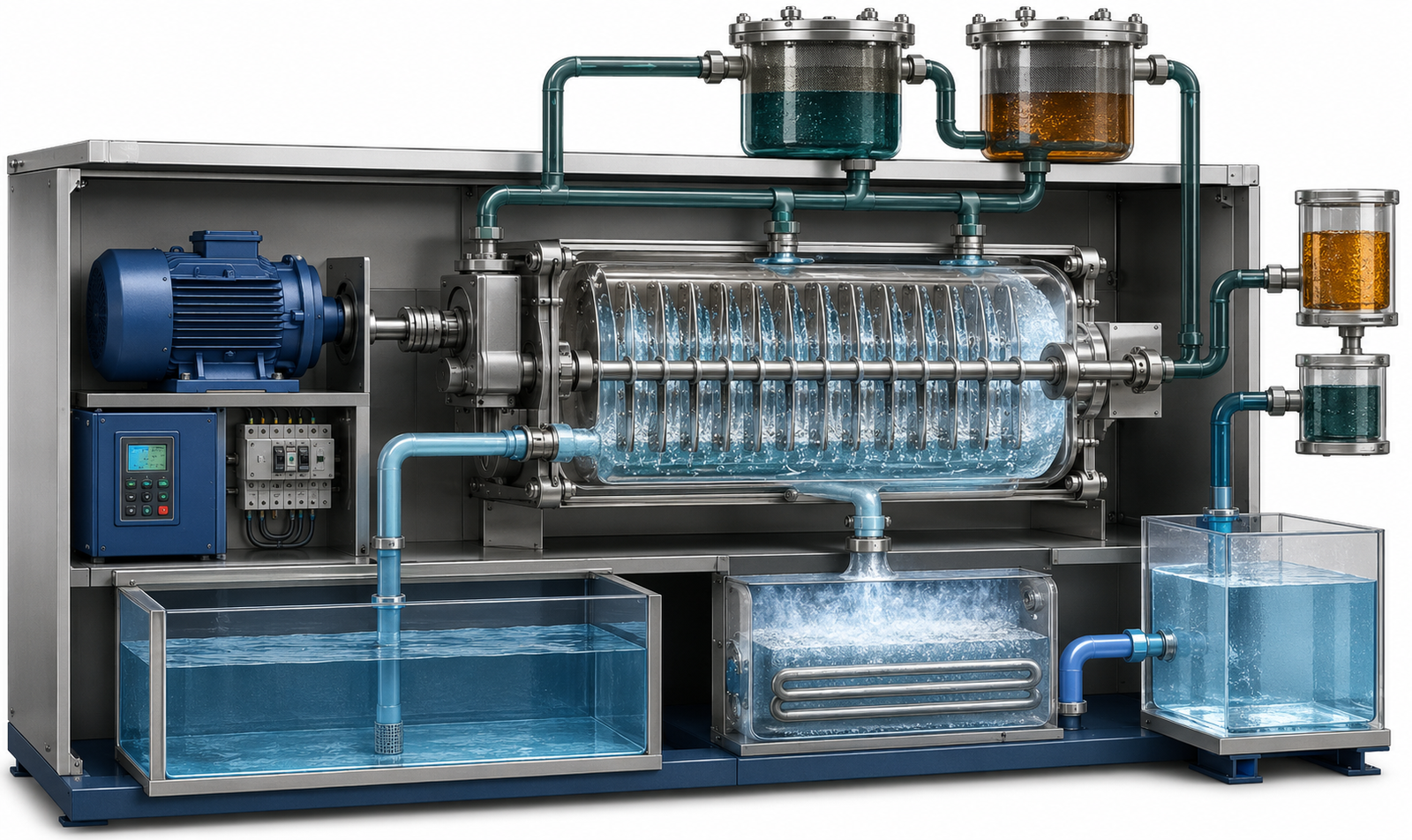
This illustration explains the patent’s overall system relationships. It is not a construction drawing and does not depict Blue Vortex Technologies’ proposed proprietary prototype geometry.
Making it real
The next development phase is a compact, transparent, single-chamber system that makes the essential behavior visible, adjustable, and measurable.
Clean water enters a controlled, transparent test chamber.
A purpose-designed rotor directs the flow outward at high speed.
Rotor-stator interaction establishes localized pressure conditions.
A measurable low-temperature vapor stream is separated and collected.
Conceptual description only. Proprietary geometry and operating details are intentionally omitted.
Later application work could evaluate different incoming water sources, determine uses for the recondensed clean water, and recover useful thermal energy. After the residual brine is separately concentrated, crystallized, and dried, the resulting solid salts and potentially valuable trace minerals could be evaluated for responsible recovery rather than treated only as waste.
A future research pathway could examine whether selected recovered sodium compounds can be refined into feedstocks for sodium-based energy-storage materials. Battery-grade conversion would require additional chemical and materials expertise, with EECS supporting storage-system controls and integration.
A proposed UCI M.Eng. Capstone initiative
Blue Vortex Technologies is seeking a cross-disciplinary student team to design, instrument, and test a compact prototype using ordinary clean water. This first project is about the machine itself: create a measurable vapor stream, capture and recondense it, recover useful heat, quantify performance, and identify the most promising development path.
Student roles and skillsets
Each discipline answers a different part of the same question: can Blue Vortex create, control, capture, recondense, and beneficially reuse a meaningful vapor stream? Their work converges in one instrumented machine and one shared body of evidence.
Why they participate: Vapor production and recovery depend on the machine’s geometry, rotational motion, fluid pathways, thermal design, structural integrity, and safe operation.
Why they participate: The prototype cannot produce defensible evidence unless it is precisely controlled, comprehensively sensed, intelligently automated, computationally modeled, and supported by trustworthy software and data analysis.
Why they participate: The clean-water prototype should demonstrate not only that vapor is produced, but how it can be captured, recondensed, thermally integrated, and put to beneficial use.
How the teams work together
The clean-water prototype is interdisciplinary from end to end. Mechanical components create and recover the vapor; EECS makes every condition controllable, visible, and repeatable; Environmental Engineering connects vapor capture, condensation, heat recovery, and beneficial water use into a complete recovery system.
Jointly establish operating ranges, CFD assumptions and boundary conditions, vapor and condensate measurements, heat-recovery objectives, instrumentation, safety limits, and clear success criteria.
Mechanical students build the chamber, impeller system, vapor path, condenser, and heat exchanger; EECS integrates the drive, sensors, controls, software, and data system; Environmental students define recovery and reuse measurements.
Run controlled combinations of speed, flow, pressure, and component configuration while measuring vapor production, capture efficiency, condensate volume, heat transfer, energy use, and stability.
Compare CFD predictions with sensor data, then connect impeller and internal-component choices with vapor recovery, thermal performance, energy use, and usable water output to select the next design iteration.
The teams can evaluate vapor capture, elevated recondensation, heat exchange, and recovered-water use through defined system interfaces without disclosing the proprietary geometry responsible for vapor formation.
What success looks like
Student opportunity
Blue Vortex Technologies is looking for UCI students who are inventive, technically rigorous, and excited by the possibility of advancing water resilience through mechanical design, EECS, vapor capture, heat recovery, and disciplined experimentation.
Request the nonconfidential project briefAbout Blue Vortex Technologies
Blue Vortex Technologies is an early-stage water-technology company advancing a body of rotating-flow and vapor-recovery work rooted in earlier Wallace and Verno inventions. Our present focus is engineering validation: translating that foundation into a compact, transparent, instrumented system that can be measured, refined, and responsibly evaluated for water-recovery applications.
Context: UN-Water global access data · U.S. Bureau of Reclamation Colorado River data · U.S. EPA water-reuse information. Blue Vortex Technologies applications shown above are development goals, not established performance claims.